Good Morning, Yoga comes from an Indian word meaning
to unite. Yoga is a means of restoring a healthier balance to body and mind so
that you are better able to cope with the stresses and strains of modern life.
Good Morning, Yoga comes from an Indian word meaning
to unite. Yoga is a means of restoring a healthier balance to body and mind so
that you are better able to cope with the stresses and strains of modern life.
Yoga (exercises) re-align, purify and strengthen the body, mind and
spirit. Practices
begin with the outermost aspect of the personality
- the physical body. Asanas help to keep the body
healthy by removing tensions and massaging the
internal organs, thereby improving their function
and giving greater flexibility to the spine,
muscles and joints.
All forms of yoga comprise 3 elements
1. Pranayama (breathing)
2. Asanas (postures)
3. Dhyana (meditation)
Asanas
Yoga practice begins with the outermost aspect of our form, the body. Asanas (set movements) help to keep the body healthy by removing tensions and massaging the internal organs, thereby improving their function and giving greater flexibility to the spine, muscles and joints.
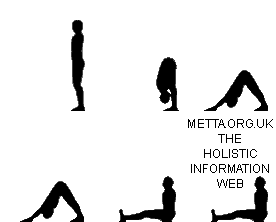
The Sun Salutation
There are 24 movements comprising of 12 on the right side and
12 on the left side. The Sun Salutation is not considered as asanas because it
is a dynamic movement exercise. Asanas are static. The Sun Salutation is an
excellent warm up exercise which should not be left out and can ideally
follow a brief medative sitting 'arrival stage'. The sun salutation warms each part of
the body prior to starting to practice each of the asanas (Within Astanga these
movements are often referred to as the Primary Series). When working in a
general open class a shorter session of about 7 right and 7 left side
salutations are practiced. In advanced classes you can normally expect to
perform around 10 - 12. The important thing is each movement should be
synchronising with the breath, and the breathing should be deep and slow.
Virtually all Yoga is practiced with strong emphasis on breathing in
relationship with the movement into the posture or pose - Asana.
Pranayama
Pranayama is the exercise of the breath. Breathing techniques are important
within Yoga not only for improving the supply of oxygen to the body but also for
strengthening the lungs, but the way we breath also has a direct effect on the brain and emotions, balancing the nervous system and putting us in touch with
deeper energies and many other aspects of our being.
There are many types or forms of Yoga, here is
a brief description of some.
Astanga Vinyasa
Astanga (Ashtanga) Vinyasa Yoga or Power Yoga as it is often known as in
the USA has become very popular in the UK over the past few years. It is a
fairly physically demanding form of yoga which leads to the
following and "performance" of set movements which
are known as the Primary Series. Specifically seeking to unify the
actions of body, breath and mind by linking movement and breath.
Astanga is often criticised as being far to energetic
rather than contemplative and is perhaps described as more of a fitness regime
rather than a pure form of Yoga, this criticism may have some justification if
the movements and postures are not taught correctly. If taking up Astanga
without any previous experience of Yoga it is advisable to work with a well
qualified teacher who has many years of experience.
Bhakti Yoga
Bikram Yoga
This form should be practiced in a specially
heated room (Hot!) and is not for the feint hearted! Bikram Yoga consists of around
26 dynamic movements which run in a set order over about 90 minutes. Bikram Yoga
is relatively new to the UK and is
becoming very popular, but does need to be practiced within a specially prepared
and heated space.
Hatha Yoga
Usually
considered as a name for general yoga and often
considered as an all encompassing form which encompasses movement, breath and
alignment.
Iyangar Yoga
The Iyengar method of yoga
uses a variety of props to enable students to
achieve the best possible position in the asanas,
so making it accessible to the stiffest and un
practiced person of any age. Exercises are
graded to ensure safe progression from complete
beginner to competent yogi.
Jnana Yoga
Karma Yoga
Loosely translated means
"working with awareness". The integration
of yoga into daily work, breath and movement
used to benefit the whole body during daily life
without
the need for any reward, gratitude or reward,
whilst being totally in the moment,
this is the ideal of Karma Yoga.
Kriya yogas
Kundalini
Yoga
Kundalini yoga
is used to open the Chakras (energy centres).
Laya Yoga
Mantra Yoga
Raja Yoga
Is focused on
the art of concentration techniques for the mind
Sivananda Yoga
Tantra Yoga
Viniyoga